Engineering Your Own Exit: Why Deletion is the Ultimate Senior Flex
Introduction: The Paradox of Permanence
Engineers are builders by nature. We take pride in the longevity of our creations, often measuring our success by how many years a system remains in production. We speak of “future-proofing” as if it were a holy grail, and we treat our code as a digital monument to our intellect. However, this obsession with permanence is exactly what leads to the most toxic patterns in software engineering: rigid monoliths, technical debt, and knowledge silos.
The ultimate engineering flex is not writing code that lasts a decade. The ultimate flex is deleting it.
The tech industry is currently facing a reality check. We have spent years building massive abstractions to predict future needs that never materialized. We have seen engineers hoard knowledge to make themselves indispensable, creating a “bus factor” of one that holds entire organizations hostage. This behavior does not protect your job; it creates stagnation for both the company and your career.
In a healthy, high-performing organization, code should have an expiration date. The true mark of elite seniority is the ability to design for deletion. This means building systems that can be cleanly removed and replaced in two years without causing a global outage. It also means building an environment where you, as the creator, can be seamlessly replaced without breaking the team’s momentum. We must shift our mindset from building for eternity to building for the inevitable end.
The Anatomy of Ephemeral Architecture
To build a system that can be deleted, we must rethink how we handle boundaries. Ephemeral architecture is not about building things that are “cheap” or “low quality.” It is about building things that are highly modular and strictly isolated.
Microservices Done Right
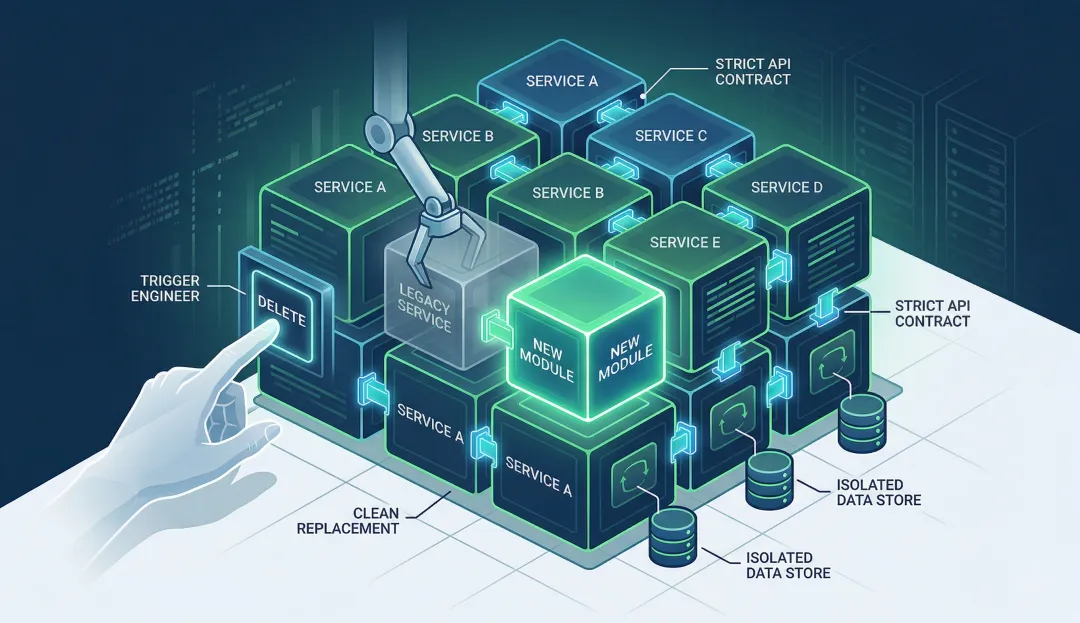
Microservices were originally promised as a way to scale teams and technology. In many cases, they simply became a distributed monolith because the boundaries were poorly defined. A truly “deletable” microservice is one that is small enough to be completely rewritten by a single team in one or two sprints. If a service requires six months of effort to replace, it is too large and has become a liability. Boundary enforcement is the most critical part of this process. Every service must be a black box where the internal logic can be gutted and replaced at any time, as long as the external contract remains stable.
Strict API Contracts as Firewalls
API contracts are your primary defense against technical debt. Think of them as firewalls. If you have a well-defined, versioned API, the underlying implementation is irrelevant. This allows teams to experiment with new languages, frameworks, or architectural patterns within a single service without affecting the rest of the ecosystem. When a service outlives its usefulness or becomes too expensive to maintain, you can simply spin up a replacement that fulfills the same contract and flip the switch. The old code is deleted, and the system continues to function.
Data Decoupling and Isolation
The hardest part of deleting code is usually the data. Tangled database schemas are the primary reason why legacy systems are so difficult to retire. To enable deletion, every service must own its data store exclusively. There should be no cross-service database joins or shared tables. If you need to drop a service, you should be able to cleanly drop its tables without leaving behind orphaned data or broken dependencies in other parts of the system. This level of isolation requires more upfront design work, but it is the only way to ensure that your architecture remains agile over the long term.
The Metrics of Deletability
How do we know if a system is actually deletable? We need objective metrics to measure the health of our architecture beyond simple uptime or latency.
The Blast Radius Test
The “Blast Radius” test is a thought experiment that every senior engineer should perform regularly. Ask yourself: “If I were to delete this specific module or service today, what would happen?” If the answer involves modifying five other services and updating three different client applications, you have failed the test. Your system is not ephemeral; it is a tangled web of dependencies. A healthy system has a minimal blast radius. Deleting one component should result in a clean failure at the boundary, not a cascading collapse of the entire platform.
High Cohesion and Loose Coupling
These are old concepts, but they are more relevant than ever in the age of rapid replacement. High cohesion means that everything within a module belongs together. Loose coupling means that the module has very few dependencies on the outside world. When you achieve this balance, deletion becomes a trivial operation. You can simply unplug the module and plug in something else. If you find yourself constantly navigating through layers of “wrapper” code just to understand a simple feature, you are likely dealing with a system that was built to be permanent rather than deletable.
Time-to-Rewrite (TTR)
We often talk about MTTR (Mean Time To Recovery), but we should also be measuring TTR (Time-to-Rewrite). This is a proposed metric that measures how long it would take for a fresh team of competent engineers to replace a specific component from scratch. If the TTR for a single service is more than three months, that service has become too big. It has reached a level of complexity where it is “too big to fail” and, consequently, “too big to improve.” By keeping TTR low, you ensure that no part of your codebase ever becomes a permanent anchor that drags down the rest of the organization.
The Ephemeral Engineer: Preparing for Your Own “End”
The principle of deletion applies to people just as much as it applies to code. Every engineer will eventually be replaced on the systems they build. Whether you are promoted, move to a different company, or the business goals shift, your time on a specific project is temporary. Resisting this reality creates friction. Embracing it creates freedom.
The Inevitability of Replacement
Many engineers fear being replaced. They believe that their value lies in being the “only one” who knows how a specific system works. This is a trap. If you are the only person who can fix a bug in a legacy system, you are not indispensable; you are a bottleneck. You are stuck maintaining that system forever, unable to move on to more interesting challenges or higher levels of leadership. True seniority means engineering yourself out of a job. It means writing code that is so intuitive and documentation that is so clear that your successor doesn’t need to be a hero to maintain it.
Anti-Hero Engineering
The tech industry loves the “10x Hero” who stays up all night to fix a critical production issue. While this might be necessary in a crisis, it is a sign of a failed engineering culture. A true senior engineer is an “Anti-Hero.” They build systems that don’t require heroics. They set clear targets, establish robust monitoring, and create repeatable processes. They prioritize the success of the team over their own personal glory. When an Anti-Hero leaves a project, the team barely notices a change in velocity because the foundations were built for transition.
Avoiding the Identity Trap
It is easy to tie your professional identity to a specific codebase, tech stack, or architectural decision. When someone suggests replacing your system, it can feel like a personal attack. This ego-driven attachment is the enemy of objective engineering. When you accept that your work is temporary, you divorce your ego from the code. This allows you to make fair, objective judgments about when a system needs to die. You become the first person to advocate for deleting your own code when a better solution becomes available. This mindset is what separates a technician from a true leader.
The Cultural Shift: Motivation and the Sunk Cost Fallacy
Building for deletion is not just a technical challenge; it is a cultural one. It requires a fundamental shift in how we reward and motivate engineering teams.
Killing the Ego
Code is a tool to solve a temporary business problem. It is not a monument to your intellect. We must foster a culture where deleting code is celebrated as much as shipping it. Engineering leaders should regularly ask their teams which parts of the codebase they can remove. When a team successfully retires a legacy service, it should be treated as a major milestone, complete with a retrospective on what was learned and how the new system is better.
The Sunk Cost Fallacy in Engineering
We often keep legacy systems alive simply because we have already invested so much time and money into them. This is the sunk cost fallacy in action. The money spent on building the old system is gone. The only question that matters is: “What is the most efficient way to solve our current problem?” If the answer is to scrap the old system and start over, then that is what we should do. Giving teams the psychological safety to admit when a system has reached the end of its life is crucial for maintaining high performance.
Environment and Performance
Heavily entangled legacy codebases are a primary cause of developer burnout. When engineers feel trapped in a “maintenance loop,” unable to make meaningful improvements because of the weight of the past, their motivation dies. Knowledge gatekeeping creates a toxic environment where communication breaks down and silos form. By prioritizing deletability and replaceability, you create an environment where engineers feel empowered. They know they aren’t trapped with their mistakes forever. They know they can innovate, experiment, and ultimately move on to the next big challenge.
Celebrating the “Delete” Key
Engineering leaders must change the incentives. If you only reward the delivery of new features, you will inevitably end up with a bloated, undeletable mess. Instead, start rewarding “line-count reduction.” Celebrate the engineer who finds a way to remove 1,000 lines of redundant code. Reward the team that successfully hands off a project to another team with zero friction. These are the true markers of a high-functioning engineering organization.
When we prioritize deletion, we are prioritizing agility. We are ensuring that the business is never held hostage by its past code or the egos of its creators. We are building a culture of continuous renewal, where the best tool for the job is always the one we are using today, not the one we were using five years ago.
Conclusion: Build It, Ship It, Scrap It
Technology moves too fast to build for eternity. The frameworks we use today will be obsolete in five years. The business problems we are solving today will change in six months. Human capital is too valuable to waste on maintaining systems that should have been retired long ago.
The best way to future-proof a business is to ensure it is never held hostage by its past. This requires a commitment to ephemeral architecture, a focus on the metrics of deletability, and a personal dedication to being a replaceable engineer. We must stop trying to build digital monuments and start building flexible, modular solutions that serve a specific purpose for a specific time.
Build your systems with the intent to delete them. Write your code so that the next person can replace it with something better. Engineer yourself out of your current role so you can step into the next one. This is the only way to stay relevant in an industry that never stops moving. The era of the permanent system is over. The age of deletion has begun. Build it, ship it, and when the time comes, be the first one to hit the delete key.