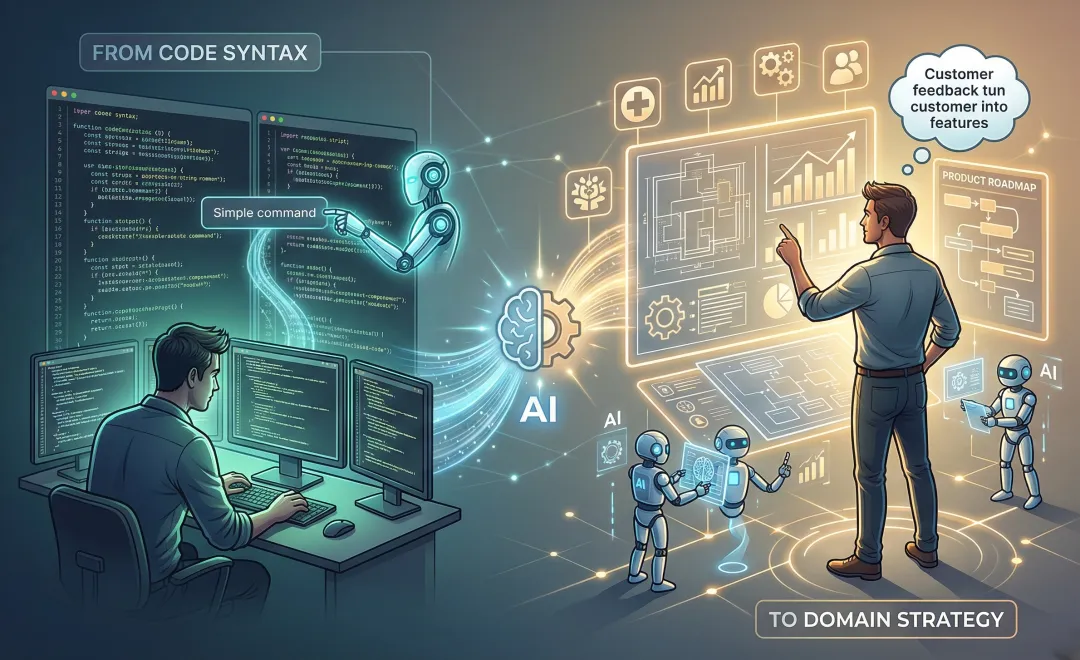
From Code to Strategy: Why AI is Forcing Developers to Become Domain Experts
I. Introduction: The Commoditization of Code
The software engineering landscape is currently undergoing its most radical transformation since the invention of the high-level programming language. For decades, the primary value proposition of a developer was their ability to translate human intent into a syntax that machines could execute. This translation process was slow, expensive, and required years of specialized study to master. If you knew how to write C++, Java, or JavaScript, you possessed a rare and valuable skill. You were the gatekeeper to the digital world.
But that gate is now swinging wide open.
We have entered an era where AI can now write boilerplate, debug complex memory leaks, and generate entire functions or even small applications in seconds. Tools like GitHub Copilot, Cursor, and various large language models (LLMs) have fundamentally changed the economics of software development. The cost of generating a line of code is rapidly approaching zero. When an LLM can produce a perfectly formatted React component or a robust Python script faster than a human can type a single comment, we must ask ourselves a difficult question: If the cost of generating code is dropping to zero, what happens to the person whose job was to write it?
This is the central paradox of the modern developer’s career. We are seeing a profound paradigm shift where writing syntax is no longer a protective moat. In the past, a developer could hide behind the complexity of a framework or the esoteric nature of a specific library. Today, those technical barriers are crumbling. The bottleneck in software development is shifting from how to build a solution to what we should be building in the first place.
The future developer will not be judged by their mastery of a specific framework or their ability to memorize API endpoints. Instead, they will be judged by their deep domain knowledge and their ability to rapidly translate customer needs into working software. The era of the pure “coder” is ending; the era of the “Product Engineer” and the “Domain Expert” has begun.
II. The Shift: From “Code Translators” to “Domain Experts”
To understand where we are going, we must first look at where we have been. Historically, the software development process was a series of translations. A customer would have a problem, which they would explain to a product manager. The product manager would then translate that problem into a set of requirements, often in the form of a JIRA ticket or a specification document. Finally, the developer would take those English requirements and translate them into a programming language like Python, JavaScript, or C++.
In this traditional model, the developer acted as the final translator in the chain. Their primary value was their fluency in the “foreign language” of code. They didn’t necessarily need to understand the underlying business model or the specific pain points of the end user as long as they could accurately implement the requirements provided to them.
Today, however, AI is now the translator. LLMs are exceptionally good at taking structured or even semi-structured English descriptions and turning them into functional code. This means the traditional role of the “code translator” is being automated away. When the machine handles the translation, the human’s role must evolve.
The developer’s new job is providing the precise context, constraints, and business logic that AI lacks. An AI can write a sorting algorithm or set up a database schema, but it cannot understand the subtle nuances of a specific industry. For example, an AI doesn’t inherently understand the complex nuances of healthcare compliance (HIPAA), the intricacies of international supply chain logistics, or the shifting landscape of fintech regulations. It can only generate code based on the data it has been trained on, which is often generalized and lacks the specific “tribal knowledge” of a particular business domain.
This is why domain knowledge is the new competitive advantage. The most valuable developers in the coming decade will be those who deeply understand the industry they are building for. If you are building a platform for insurance claims, your value isn’t just knowing how to use Kafka or Postgres; it’s knowing how insurance claims actually work, what the edge cases are, and where the most common points of failure occur in that specific business process.
When you possess deep domain expertise, you can guide the AI with much higher precision. You can provide the right constraints and identify when the AI’s output, while syntactically correct, is logically flawed for that specific industry. You are no longer just a builder; you are an architect of solutions who uses AI as a high-powered tool.
III. The Convergence: Merging the PM and Dev Roles
As the execution phase of software development (the actual writing of code) becomes faster and cheaper, the traditional organizational structures are starting to feel increasingly obsolete. The current bottleneck in many companies is the “telephone game” that occurs between different departments.
The traditional cycle usually looks like this: A customer speaks to a salesperson, who speaks to a product manager (PM), who writes a JIRA ticket, which is then picked up by a developer, who writes the code, which is then passed to a QA engineer for testing. This process is inherently slow and prone to context loss at every handoff. By the time the code reaches the customer, it often fails to solve the original problem because the “intent” was lost during the multiple layers of translation.
With AI drastically reducing the time it takes to execute code, we are seeing the emergence of the “Product Engineer.” This is a role where the traditional boundaries between product management and engineering are blurred.
In this new model, the person talking to the customer and understanding their pain points is the exact same person prompting the AI, architecting the solution, and shipping the feature. This removes the friction between customer feedback and the codebase. When the “cost of shipping” is high, you need PMs to carefully gate what gets built. But when AI makes the “cost of shipping” extremely low, the developer can move directly from understanding a customer problem to deploying a solution.
This convergence creates a much tighter feedback loop. Instead of waiting weeks for a feature to move through the pipeline, a Product Engineer can prototype, test, and iterate in a matter of hours. They can have a conversation with a user in the morning and have a functional version of a requested feature running in production by the afternoon.
The implications for this are profound. Developers who resist this change and try to stay “in their lane” of pure engineering will find themselves sidelined. The most successful engineers will be those who embrace product sense and user empathy. They will learn how to interview users, how to analyze usage data, and how to prioritize features based on business value rather than technical curiosity.
IV. The CEO’s Reality Check: Why “Replace” Failed and “Transform” Wins
In the early days of the current AI boom, many business leaders and CEOs had an “Executive Illusion.” They looked at the capabilities of tools like Copilot and assumed they could simply halve their engineering headcount and let AI do the rest. The logic was simple: If AI makes a developer 2X more productive, then we only need half as many developers to get the same amount of work done.
However, this “cost-cutting” mentality has largely failed in practice. CEOs who attempted to replace their experienced engineers with a smaller team of “AI prompters” quickly ran into the trap of unsupervised AI.
AI, when left to its own devices without deep human oversight, tends to generate rapid technical debt. It might solve the immediate problem described in a prompt, but it often does so in a way that is disconnected from the broader system architecture. It can hallucinate business logic that sounds plausible but is factually incorrect. It can also introduce subtle security vulnerabilities that are difficult for an untrained eye to spot.
Most importantly, AI cannot take accountability for business outcomes. If a piece of AI-generated code causes a major data breach or a system outage that costs the company millions of dollars, the AI doesn’t care. You cannot fire an LLM. You cannot hold an algorithm accountable for a strategic failure.
The real ROI of AI in software engineering isn’t reducing the payroll; it’s accelerating the time-to-market. Forward-thinking CEOs have realized that the goal isn’t to have fewer engineers, but to have more “Product Engineers” who can move faster and solve more complex problems.
The true business benefit comes from transforming developers into strategic partners. Instead of viewing the engineering department as a cost center, successful businesses view it as a revenue generator. By empowering developers with AI and encouraging them to become domain experts, businesses get higher-quality features shipped exponentially faster. The win is in revenue generation and outmaneuvering competitors, not just in cutting the IT budget.
V. The Future Skill Stack: What Developers Need to Learn Now
If the traditional skill set of a developer (languages, frameworks, syntax) is becoming commoditized, what should a modern engineer focus on? The new “Skill Stack” for the AI era looks very different from the one we relied on for the last twenty years.
1. Systems Architecture over Syntax
As AI handles the individual functions and components, the developer’s role shifts to the higher level of systems architecture. You need to understand how different AI agents, databases, microservices, and APIs fit together to form a secure, scalable, and maintainable system. You are the conductor of an orchestra of AI agents. You must know how to design systems that are resilient to the occasional “hallucinations” of an AI and how to create guardrails that ensure the AI-generated parts of the system behave predictably.
2. Product Sense and User Empathy
This is perhaps the most difficult skill for many traditional engineers to acquire, but it is also the most valuable. You must learn to think like a product owner. This means understanding the “why” behind every feature. It means being able to look at a user interface and understand where the friction points are. It means having the discipline to say “no” to a technically interesting feature that doesn’t actually solve a user problem.
3. Prompt Engineering and AI Orchestration
While “prompt engineering” is often mocked as a temporary fad, the underlying skill is actually very deep. It is the ability to communicate complex logic, architecture, and business constraints to an LLM effectively. This requires a high degree of clarity in thought and language. To get a great result from an AI, you must first have a perfectly clear mental model of what you want to achieve. The better you can articulate your domain knowledge and your technical constraints, the better the AI can assist you.
4. Critical Code Review and Security Awareness
In an era where most code is generated by AI, the role of the “code reviewer” becomes even more critical. You must be able to read and understand code faster than ever before. You need a “bullshit detector” that can spot when an AI has taken a shortcut or introduced a subtle bug. You also need a deep understanding of security principles, as AI often ignores security best practices in favor of generating a “working” solution as quickly as possible.
VI. Conclusion: An Upgrade, Not a Replacement
The fear that AI will replace software developers is based on a misunderstanding of what software engineering actually is. If software engineering were just about typing syntax into a text editor, then yes, the role would be in grave danger. But at its core, software engineering has always been about solving human problems using technology.
AI isn’t replacing developers; it is elevating them. It is stripping away the tedious, repetitive, and mechanical parts of the job to reveal the core of the profession. By automating the “how,” AI is forcing us to focus on the “what” and the “why.”
This is an upgrade for the entire industry. We are moving away from being “digital bricklayers” and toward being “digital architects.” We are gaining the ability to build more ambitious systems, to iterate faster, and to stay closer to the people we are building for.
The takeaway for any developer today is clear: Start talking to your users. Read up on your company’s business model. Understand the economics of the industry you work in. The most powerful tool in your tech stack is no longer your IDE or your favorite framework; it is your understanding of the customer and your ability to solve their problems strategically.
The future belongs to the engineers who can bridge the gap between code and strategy. AI will handle the code; you must handle the strategy. Embrace the change, dive deep into your domain, and you will find that the AI era is the most exciting time to be an engineer in history.