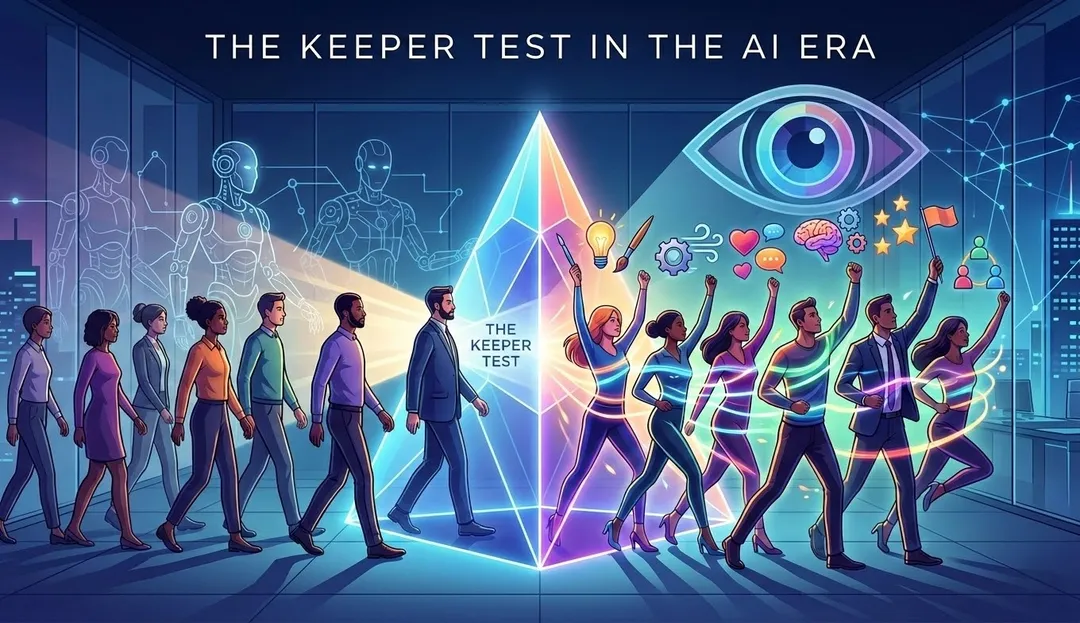
The Keeper Test in the AI Era: Building Teams That Cannot Be Automated
As artificial intelligence continues to reshape the modern workplace, leaders are facing a daunting, often uncomfortable question: With our current resources and the new tools at our disposal, who should we keep on the team? When AI can handle the baseline, human employees need to deliver exceptional value. To make these tough personnel decisions, many modern executives are turning to a ruthless but effective management philosophy: The Keeper Test.
What is the Keeper Test?
The Keeper Test boils down to a single, uncompromising question that a manager must ask themselves about every person on their team:
“If this employee told me they were leaving for a similar job at a peer company, would I fight hard to keep them?”
- If the answer is Yes, they are a keeper.
- If the answer is No (meaning you would feel relieved or indifferent), the company should let that person go immediately and look for someone they would fight to keep.
It shifts the paradigm from treating a company like a “family” (where unconditional employment is expected) to treating it like a professional sports team (where only the best players for a specific position are kept on the roster).
A Brief History: Where Did It Come From?
The Keeper Test was invented and popularized by Netflix in the early 2000s, specifically by co founder Reed Hastings and former Chief Talent Officer Patty McCord.
Following the dot com bust and a round of necessary layoffs, Hastings and McCord realized that their company functioned much better, and the remaining employees were much happier, when they were surrounded strictly by high performers. They codified this into the famous Netflix “Culture Deck,” which emphasized a concept called Talent Density.
Who still uses it? Netflix remains the most famous practitioner of the Keeper Test today. However, many high growth tech companies and startups have quietly adopted variations of this philosophy. They prioritize extreme talent density over tenure or employee comfort, even if they do not explicitly call it the “Keeper Test.”
Why Is This Important for Management Today?
In the age of AI, the Keeper Test is more relevant than ever. AI can be a great “average” employee. It can write standard code, draft basic emails, and process data. Therefore, managers no longer need humans to do “adequate” work.
The Keeper Test forces managers to be objective. It strips away emotional biases, tenure, and the temptation to keep a “nice but average” employee around simply because firing them is uncomfortable. It helps leaders identify the highly adaptable, creative, and critical thinkers: the exact people AI cannot replace.
The Benefits of the Keeper Test
When implemented correctly, the Keeper Test yields several massive advantages for an organization:
- Maximum Talent Density: You surround your best people with other top performers, which inherently boosts morale and innovation. High performers hate carrying the weight of merely adequate colleagues.
- Agility and Speed: A team of exceptional talent requires less micromanagement and fewer bureaucratic rules, allowing the company to move faster.
- Clear Expectations: It eliminates complacency. Employees know they are expected to bring their best effort every day.
- Fairness in Mediocrity: It prevents the slow, agonizing decline of keeping someone in a role they are no longer suited for.
Problems When Applying the Keeper Test and How to Avoid Them
While powerful, the Keeper Test can easily backfire and damage a company culture if applied blindly. Here are the most common problems and how leadership can prevent them:
- Problem: A Culture of Fear and Paranoia. If employees constantly feel their jobs are on the line every single day, anxiety will spike, and creativity will plummet.
- Solution: Practice the “Reverse Keeper Test.” Encourage employees to regularly ask their managers, “If I told you I was leaving, how hard would you fight to keep me?” This builds transparency and ensures no one is ever caught off guard.
- Problem: Internal Sabotage and Lack of Collaboration. In a hyper competitive environment, employees might refuse to help their peers in order to make themselves look better by comparison.
- Solution: Tie “Keeper” status to teamwork and collaboration metrics, not just individual output. Brilliant individuals who destroy team cohesion should fail the Keeper Test.
- Problem: Managerial Bias. Managers might keep people they personally like or who are exactly like them, rather than the most effective workers.
- Solution: Require managers to justify their decisions to their own superiors using objective data, 360 degree feedback, and clear performance metrics.
- Problem: Reputational Damage from Harsh Firings. Letting people go simply because they are “good” and not “great” can lead to terrible reviews on job boards and make it hard to hire in the future.
- Solution: Offer highly generous severance packages. If you are asking people to take the risk of working in a high performance culture, you must cushion the fall if it does not work out.
The Future of the Human Element
The Keeper Test is not for every company. It requires a high level of emotional maturity, extreme candor, and the financial bandwidth to offer strong severance packages. But for leaders staring down the barrel of an AI revolution, it offers a clear, effective lens to ensure that the humans driving their company forward are truly the best in the business.