The Future of Software: Next-Gen Specification Driven Development in the Age of AI Agents
The industry is currently experiencing a massive shift. Developers are rapidly adopting AI coding agents like GitHub Copilot, Cursor, Claude Code, and Lovable to write a vast majority of their code. But while these tools are incredibly effective for rapid prototyping, their default mode of interaction (the chat interface) is inherently limited.
Linear, personal chat interactions simply do not scale well for large teams building complex, production-grade systems. As we hurtle toward a future dominated by autonomous AI agents, our current methodologies are fracturing under the weight of AI-generated code.
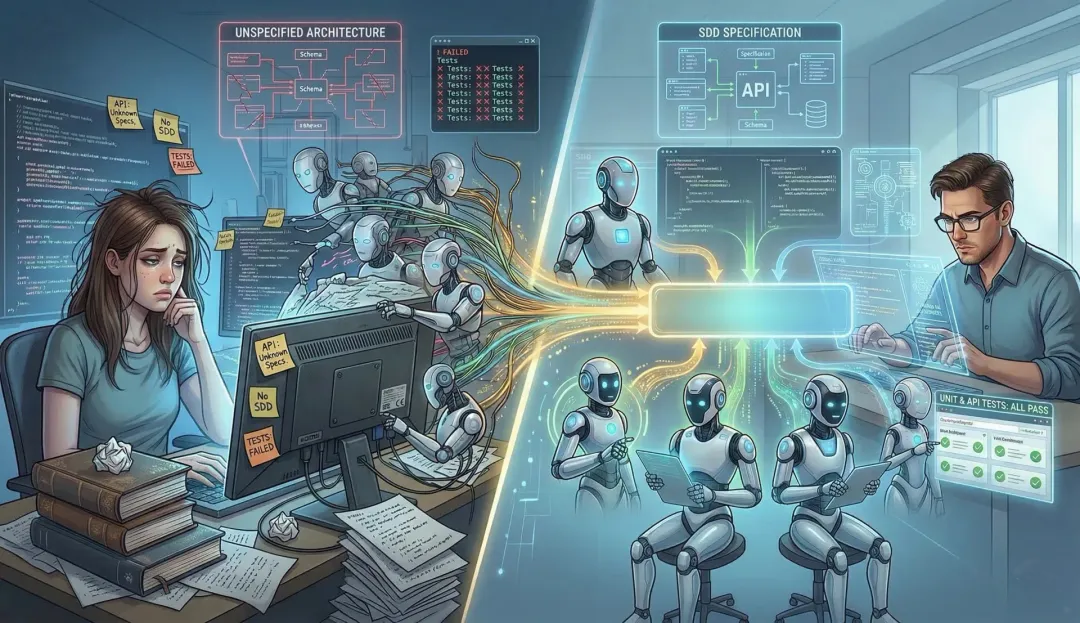
The solution lies in the evolution of Specification Driven Development (SDD). In the AI era, the specification is no longer just a tool for human alignment; it is the ultimate guardrail and compiler for human-AI collaboration.
The Core Crisis: The Problem of “Lost Intent”
Before we look at the solution, we must understand the rapidly growing problem in modern AI-assisted engineering: Lost Intent.
When a developer writes a prompt (their “intent”) and the AI generates the code, that original prompt is usually discarded. The rest of the engineering team is left staring only at the machine-generated output. Because AI agents generate code so rapidly, this creates a massive, almost insurmountable code-review burden for human developers.
If teams attempt to solve this by using AI to review AI-generated code, humans inevitably lose control over the system’s underlying logic. We become disconnected from the “why” behind the codebase.
The Solution: Next-Gen Spec-Driven Development
Traditionally, SDD meant writing strict, machine-readable contracts (like OpenAPI or GraphQL) before writing code. While those underlying contracts are still vital for system boundaries, the human input is evolving.
Pioneering approaches, like those championed by tools such as CodeSpeak, are introducing Next-Gen Spec-Driven Development. Instead of writing traditional boilerplate code or relying on AI to generate impossibly long documentation, developers write concise, high-level intents or specifications in human language.
In this model, the AI acts as the compiler.
Because the AI can infer standard boilerplate and logic (just as humans infer context in conversation), these human-written specifications can be 5 to 10 times shorter than traditional code. The specification itself becomes the primary source of truth, preserving the developer’s original intent for the entire team to see.
The Mechanics: How Agentic SDD Works in Practice
Transitioning to this AI-driven, specification-first workflow introduces unique technical challenges and brilliant new features:
- Enforcing Consistency: Human language is informal and prone to drift. A modern SDD engine must enforce consistency across large projects, ensuring, for example, that a multi-agent team doesn’t mix up the terms “tags” and “categories” when generating database schemas or UI components.
- Handling Ambiguity: When an AI agent encounters a gap in the specification, it shouldn’t guess blindly or ask open-ended questions. Instead, it is programmed to formulate specific, multiple-choice questions for the developer to clarify the intended logic before writing a single line of code.
- The “Takeover” (Code-to-Spec Conversion): What about existing projects? Emerging technical features allow teams to input legacy code and have the AI convert it backward into a concise, human-readable specification, retroactively establishing a single source of truth.
The New QA and the Death of the Manual Code Review
With the specification acting as the ultimate law of the system, the development lifecycle transforms into a parallel, multi-agent execution pipeline. The Backend Agent writes the controllers, the Frontend Agent builds the UI, and the QA Agent instantly generates robust test suites based entirely on the contract.
This is where the code-review burden of “Lost Intent” is finally solved.
In a world where AI generates thousands of lines of code in seconds, asking a human engineer to read and manually review syntax is an inefficient use of intellect. Instead, the focus shifts entirely to behavior and contracts through comprehensive testing:
- API Tests validate the backend against the spec.
- Component and UI Tests validate the frontend against mock servers spun up directly from the spec.
If the tests pass and the contract is fulfilled, the code is merged. Humans no longer review code; they review the specification and the tests. The underlying syntax is just an implementation detail.
The Enduring Need for Engineering Thinking
Does this mean software engineers are obsolete? Absolutely not. Even though AI is writing the syntax, these next-gen workflows are tools built for software engineers.
Building complex, real-world systems (whether that is a dynamic pricing model, a secure payment processor, or orchestrating a localized multi-agent framework) requires fundamental engineering thinking.
The value of a senior engineer is no longer measured by how fast they type out an API controller. Their value lies in the ability to break large problems into smaller parts, understand deep architectural trade-offs, and design fault-tolerant systems.
Food for Thought
It is important to note that everything discussed here is not a strict recommendation or a guaranteed blueprint for your next project. Rather, it is simply food for thought meant to spark a conversation about where our industry is heading.
Specification Driven Development was originally designed to bridge the gap between human developers. Tomorrow, it is the bridge between human intent and AI execution. By making concise, high-level specifications your single source of truth today, you retain control over your system’s logic while allowing AI to do the heavy lifting. In the agentic era of software engineering, code is cheap, but a well-engineered specification is everything.